What Happens Next? The Supreme Court’s New Voting Decision Explained
The Supreme Court recently issued a major decision in Louisiana v. Callais. The Court said that if people think a voting map is unfair, they now have to prove it was done on purpose. Before, they only had to show that the results were unfair. This new rule makes it harder to challenge voting laws.
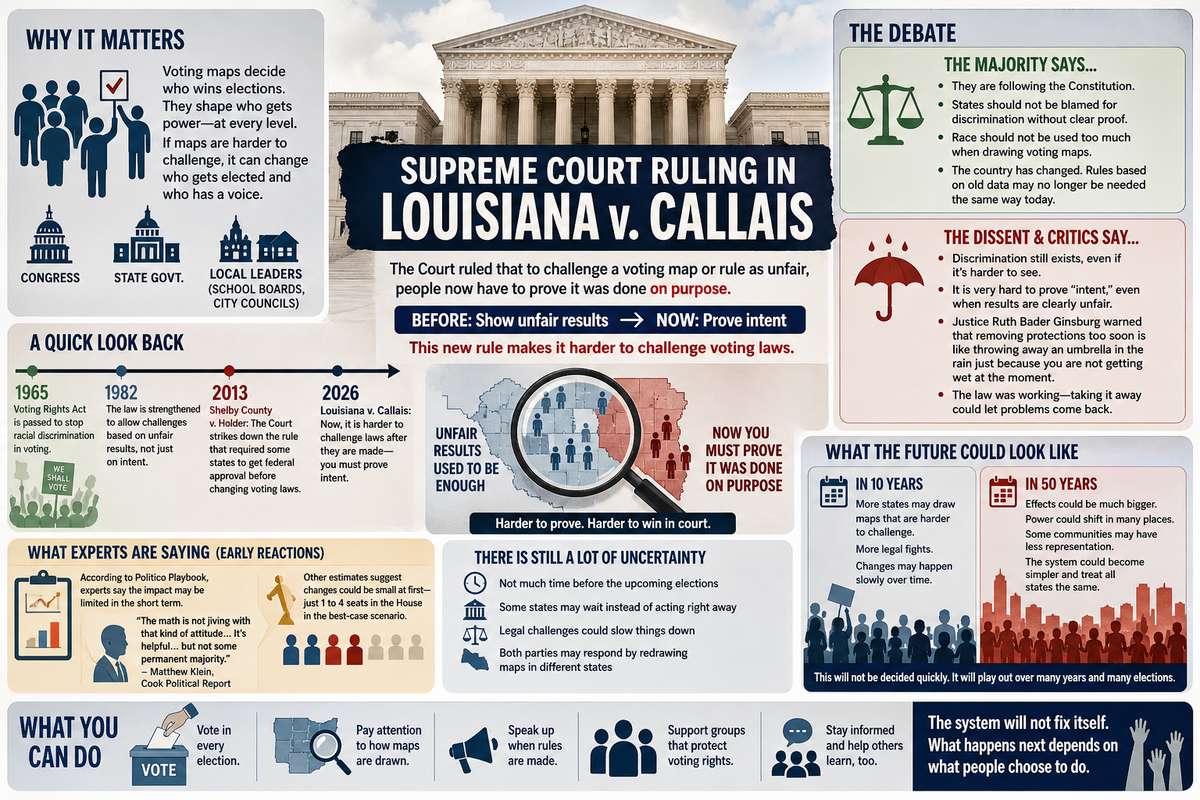
The Supreme Court recently issued a major decision in Louisiana v. Callais. The Court said that if people think a voting map is unfair, they now have to prove it was done on purpose. Before, they only had to show that the results were unfair. This new rule makes it harder to challenge voting laws.
The case began when Louisiana drew a new voting map with two majority-Black districts to comply with the Voting Rights Act, but some voters challenged it, arguing the state relied too heavily on race in drawing those lines. The Supreme Court agreed with that argument and ruled the map went too far in using race.
Voting maps decide who wins elections. They shape who gets power. This includes leaders in Congress, state government, and even at the local level, such as school boards and city/county councils. If maps are harder to challenge, it can change who gets elected and who has a voice.
In 1965, the government passed the Voting Rights Act. It was made to stop racial discrimination in voting. It helped protect people who were being treated unfairly because of their race.
Over time, the Supreme Court weakened this law. In Shelby County v. Holder, the Court struck down a rule that required some states to seek federal approval before changing voting laws. That made it easier for states to make new rules. Now, today’s decision makes it harder to fight those rules after they are made.
The Supreme Court majority says they are following the Constitution. They believe states should not be blamed for discrimination unless there is clear proof. They also say race should not be used too much when drawing voting maps.
Some justices have also said the country has changed. In the Shelby case, Chief Justice John Roberts said the rules were based on old data from many years ago. This idea suggests that some protections were intended for a different time and may no longer be needed in the same way today.
Other justices and many civil rights groups say this is dangerous. They believe discrimination still exists, even if it is harder to see. They argue that it is very hard to prove someone acted “on purpose,” even when the results are clearly unfair.
Justice Ruth Bader Ginsburg warned about this in the past. She said removing protections too soon is like throwing away an umbrella in the rain just because you are not getting wet at the moment. Her point was simple: the law was working, and taking it away could let problems come back.
Some early reactions suggest this decision could affect how districts are drawn in the next few elections, but maybe not as dramatically as some people think.
According to reporting from Politico Playbook, the impact may be limited in the short term. Analyst Matthew Klein said, “The math is not jiving with that kind of attitude… It’s helpful… but not some permanent majority.” In simple terms, that means this ruling might shift a few seats in Congress, but not completely change everything overnight.
Other estimates in the same report suggest changes could be small at first, with just 1 to 4 seats in the House in the best-case scenario for one party. Playbook also notes there is still a lot of uncertainty because:
- There is not much time before the upcoming elections
- Some states may wait instead of acting right away
- There could be legal challenges that slow things down
- And both parties may respond by redrawing maps in different states
So, while the ruling is important, experts say it may take several election cycles to see the full impact.
This affects many people, especially communities that have faced unfair treatment before. It also affects everyday elections. Local leaders make decisions about schools, safety, and money in communities. If voting maps change who gets elected, it can change those decisions, too.
In the next 10 years, more states may draw maps that are harder to challenge. There may be more legal fights, and changes may happen slowly over time.
In 50 years, the effects could be much bigger. Power could shift in many places, and some communities may have less representation. At the same time, some believe the system could become simpler and treat all states the same.
One thing many experts agree on: it will likely play out over many years and many elections.
Even with this decision, people still have a voice. Vote in every election. Pay attention to how maps are drawn. Speak up when rules are made. Support groups that protect voting rights. Stay informed and help others learn, too.
The system will not fix itself. What happens next depends on what people choose to do.